
Defining “Model Policy”
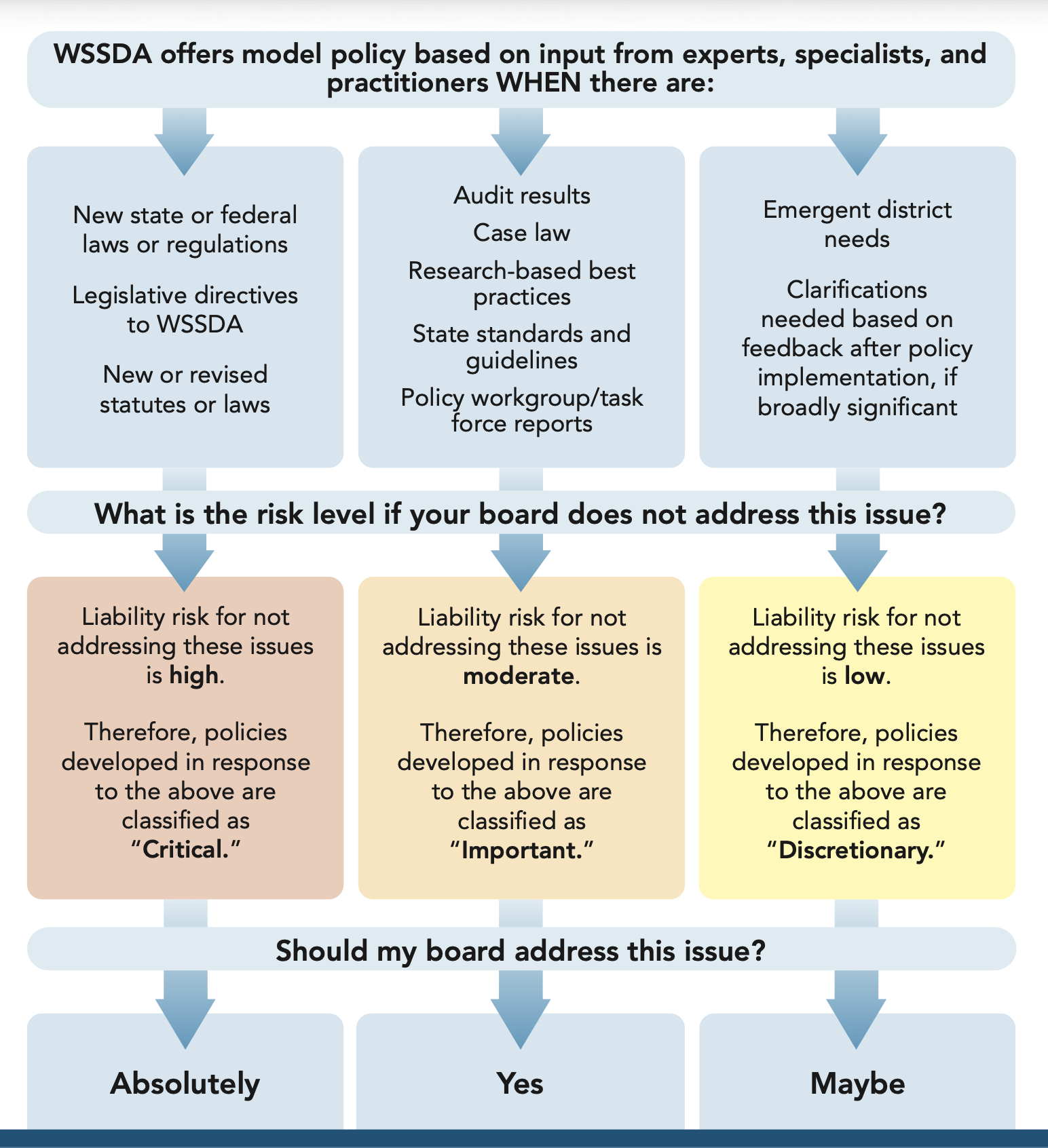
A model policy is a legally viable example of a policy that boards can adopt to ensure compliance with the law in any given situation. A WSSDA model policy falls within one of three categories, and typically comes with a companion “model procedure” to guide implementation of the policy, if adopted. School boards are under no obligation to adopt WSSDA’s models, but there are benefits to using them.
Benefits of Model Policy
For many boards, policy manual review is ongoing, so WSSDA classifies model policy to help boards prioritize where they direct their attention. Model policies are designed to provide three main benefits:
- They provide a sound legal starting point for any school board to engage in dialogue and adoption of local policies.
- They help safeguard the K-12 system by removing barriers to legal compliance.
- They can save school districts from the expenses (financial, professional, and human resource) necessary to develop policy from scratch.
Flexibility in Local Adoption
WSSDA’s model policies are not necessary or required for school boards to adopt (unless the state Legislature takes the rare step of mandating it). Also, WSSDA model policy is not set in stone. School boards, guided by legal counsel, can modify model policies and procedures to address the uniqueness of their locale or reflect input gathered from their local community as they would during a curriculum adoption process.
A Starting Point—Not a Final Destination
WSSDA’s models are not a permanent guarantee of legal compliance because laws change as new court cases occur or legislation is enacted. Because of the ever-evolving legal landscape, WSSDA model policy is not “set it and forget it.” Boards must have a process for regularly reviewing and revising their policy manual.
To help boards anticipate changes and remain current, WSSDA produces Policy and Legal News, a subscription magazine that explains the “why” behind newly developed or revised model policies, including the origin and context of the updates.
The other tool WSSDA provides is policy manual review services, where WSSDA’s policy and legal staff review a district’s policy manual and recommend updates to ensure the policies reflect current legal requirements. (The district’s school board may adopt the recommendations or not through regularly scheduled open public meetings, as with any policy adoption.)
Who Contributes to Making Model Policy?
WSSDA coordinates or leads the development of model policy with experts in school law and experts, specialists, or practitioners in whichever field is related to the law and policy in development.
At a minimum, WSSDA staff will work with a lawyer or firm that is a member of the Council of School Attorneys, a statewide association of legal firms with deep knowledge of relevant case law and litigation experience in school law. Then, depending on what the model policy was concerned with, additional partners have included:
- Washington Association of Sheriffs and Police Chiefs
- School Nurse Corps Administrators
- Washington Department of Children, Youth, and Families
- Office of Superintendent of Public Instruction
- Washington Interscholastic Activities Association
- Community-based organizations with relevant expertise, and more.
Again, the experts, specialists, or practitioners that WSSDA engages with to develop a model policy, in addition to experts in school law, depends on what the model policy is about. Here is a flow chart showing how model policy is created.
Subscribe to WSSDA Model Policy Online
Subscribers can access WSSDA’s model policy manual 24/7. Each policy contains hyperlinks to cross-referenced policies, legal references, and management resources. The annual subscription is fee is $990.
This subscription service is available only to following organizations:
- Washington state public school districts, including tribal schools and charter schools
- Washington state Educational Service Districts
- Washington state agencies that support public education, including the Office of Superintendent of Public Instruction, the State Board of Education, and the Office of the Attorney General
- Washington state Legislature
- Other state school board associations
- Attorneys who are members of the Washington Council of School Attorneys or law firms acting on their behalf
Questions?
Please use our inquiry form to submit questions. We use the form to ensure tracking and timely response to the large volume of inquiries that we receive.